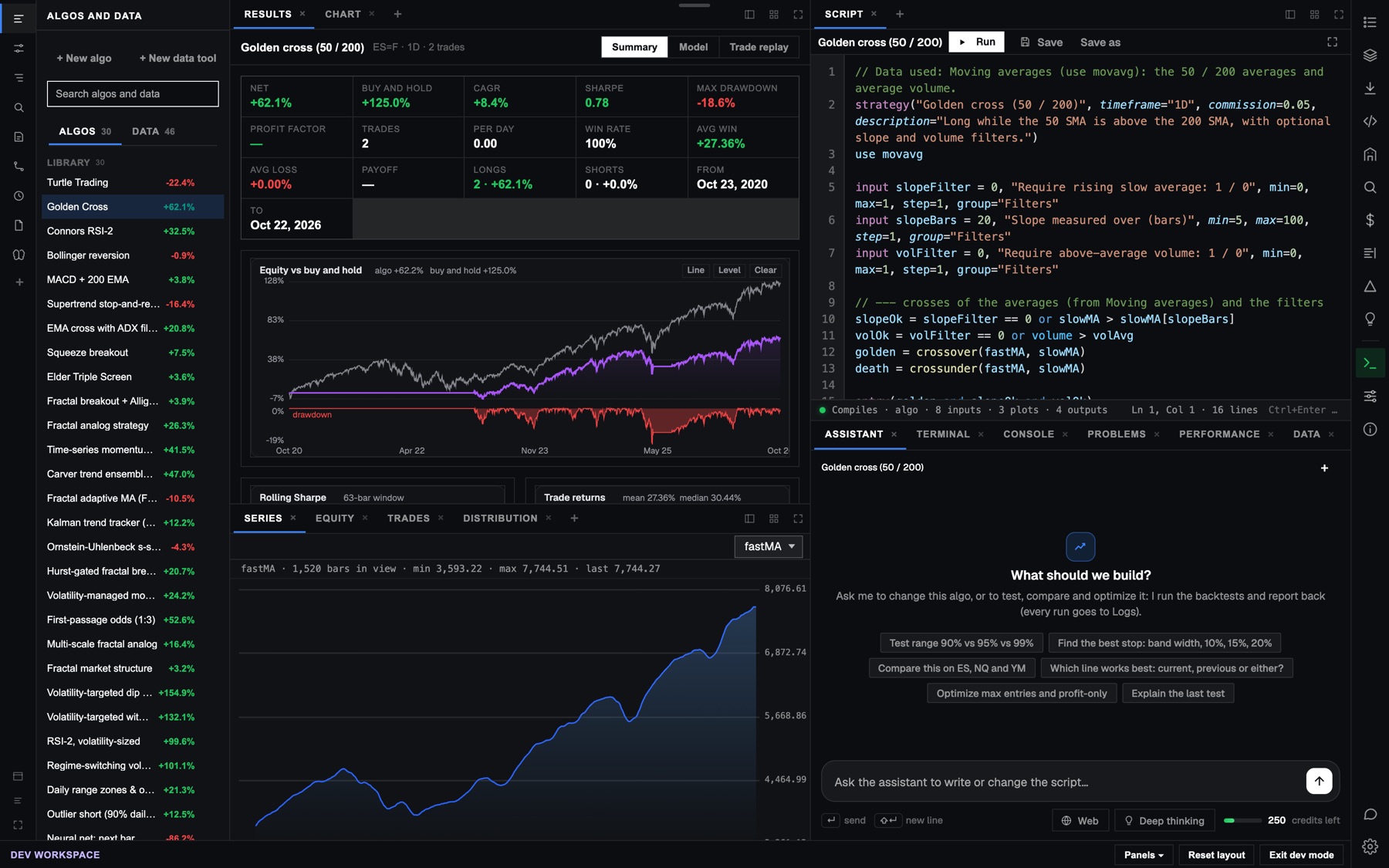
Everyone else trades the same chart. You won't.
Same indicators, same free data, same guesses: that's why most traders lose. Profitable traders have an edge the crowd doesn't. quant.trading gives you three.
Rules that have already been tested
Every algorithm ships with its backtest on years of real prices, so you start from an edge you can see instead of a hunch.
Data no one else keeps
Options walls, gamma flip and max pain recorded through every session, market regimes and live order flow, ready for an algorithm to trade.
A place to build your own
Describe an idea, and the assistant writes it, tests it on any market and period, and shows you every trade before you risk anything.
Algorithms no one else has. Proof included.
From volatility-targeted dip buying to trend ensembles, zone breaks and algos that trade the options levels. Each one is tested on ES, NQ, gold, crypto and any stock, with every entry and exit on the chart.
- Its own best market. Each algo tells you where it has held up best, and opens there.
- The numbers that matter. Net return against buy and hold, win rate, drawdown, Sharpe, and every trade with its reason.
- One click to paper. Like what you see? Put it on your paper account and watch it trade live.
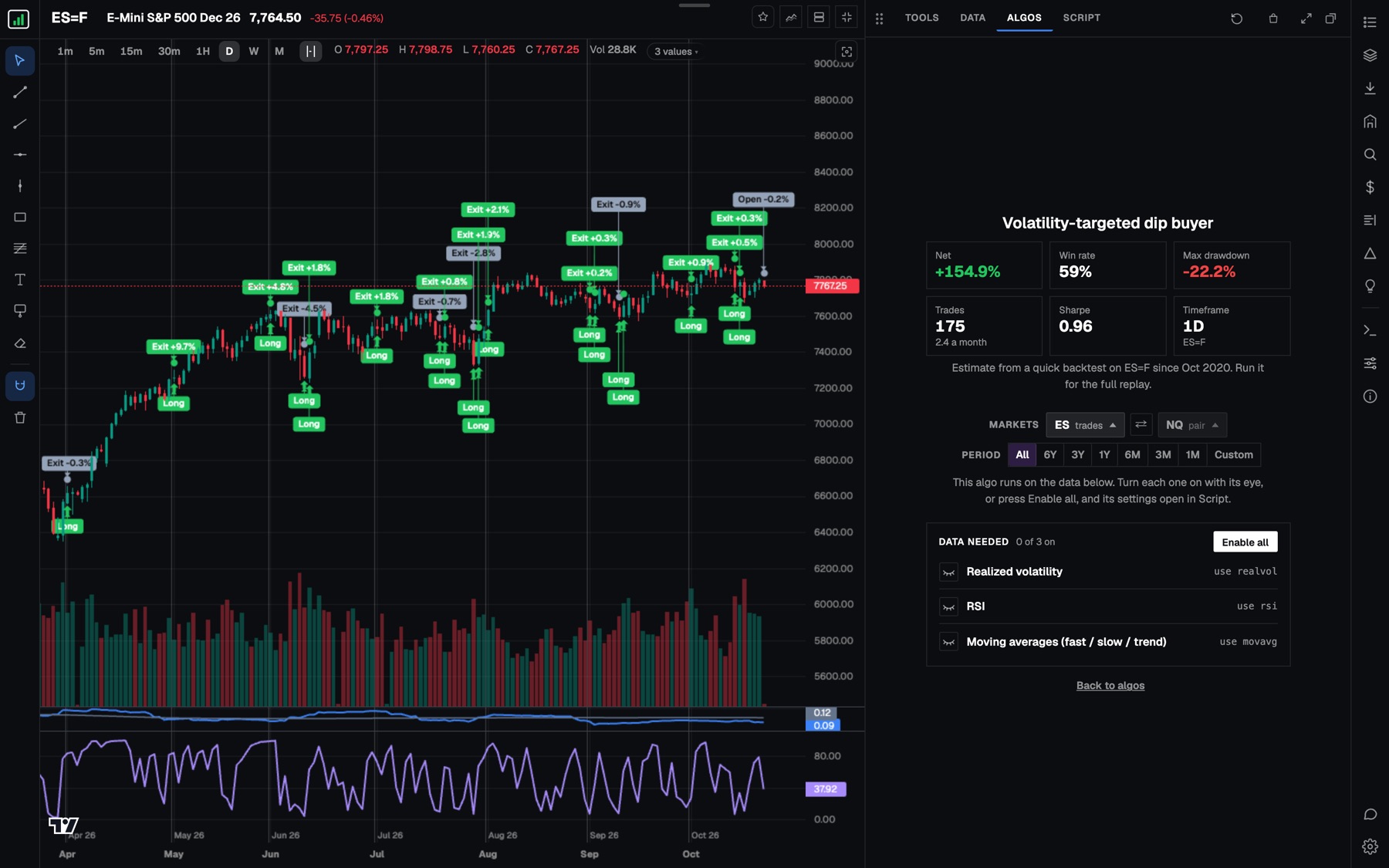
Backtests are hypothetical: no real trades were made, and past results do not predict future returns.
Data the rest of the market doesn't see.
Other platforms show today's options levels and forget them. We record them through every session, so your algorithm can trade them, and be tested against them months back.
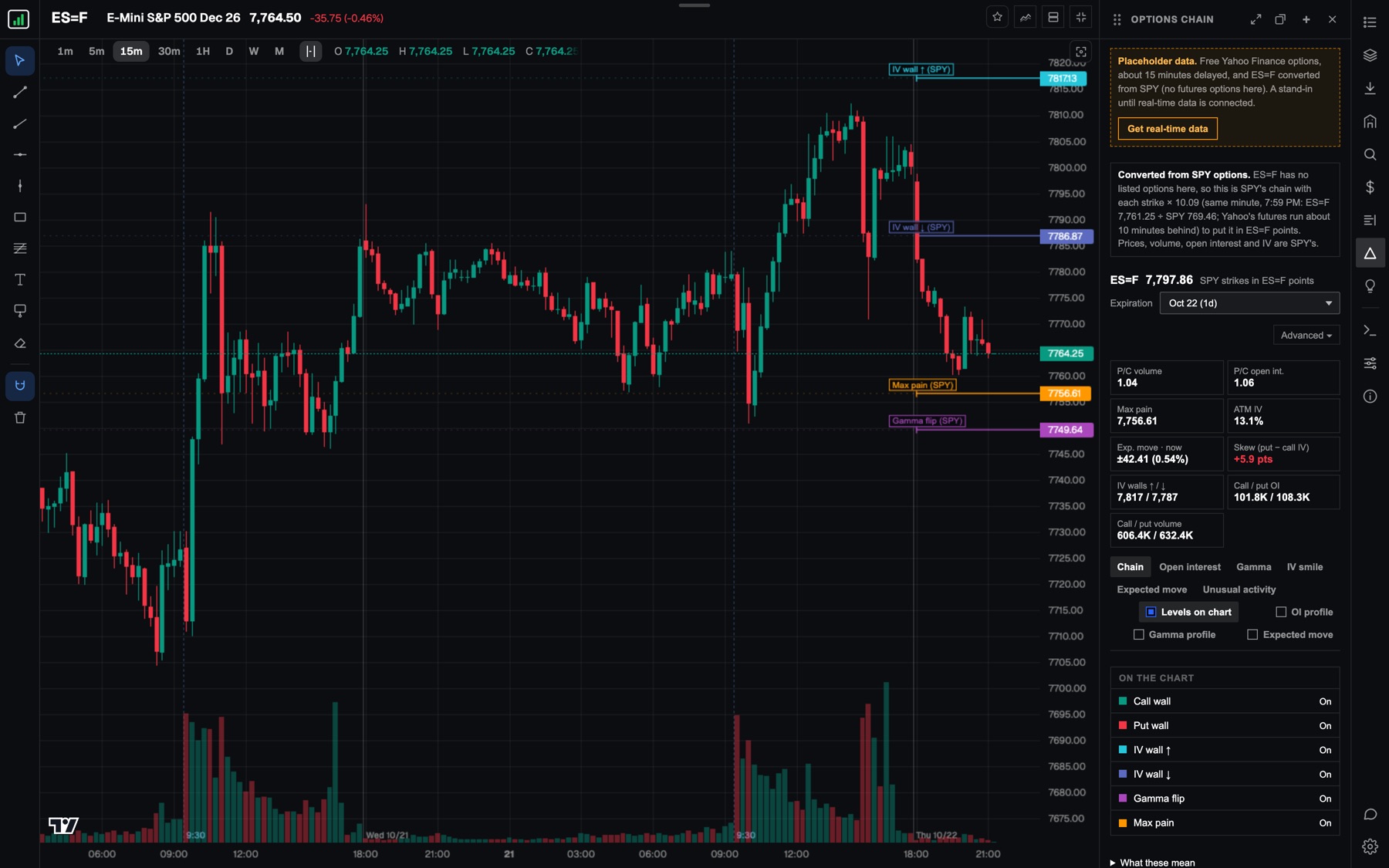
Options levels, with history
- Walls, gamma flip and max pain drawn on your chart and saved through the day.
- Algorithms can trade them, and backtests use the levels as they stood at the time.
- Expected move, skew and unusual activity from the full chain.
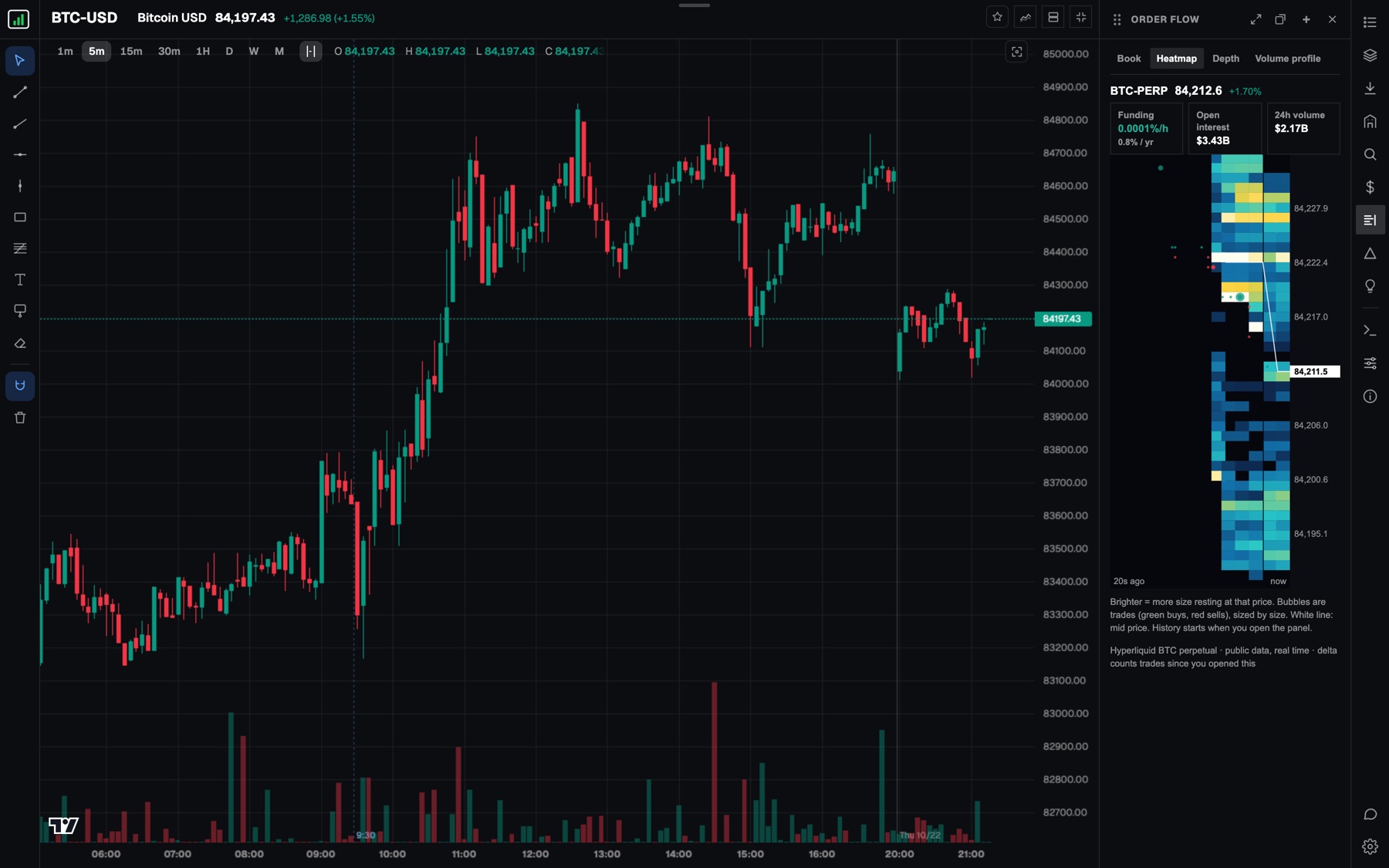
Order flow and regimes
- The live order book as a ladder, a depth chart or a heatmap of resting size.
- Market regimes: calm or volatile, trending or chopping, so an algo trades only when its conditions are there.
- A second market as confirmation: spreads and divergences between ES and NQ, gold and silver, or any pair.
Build your own edge in dev mode.
Describe an idea in plain English. The assistant writes the algorithm, tests it on any market and period, keeps every result, and asks before it changes a thing. Charts, code, results and the assistant on one screen. No code, no quant team.
Studies
Every test the assistant runs is kept: each variant with its market, return, drawdown and Sharpe. Preview one on the chart and apply the best.
Regimes
Shade the chart by market regime and let an algo trade only in the conditions where it has worked.
An assistant that asks first
It proposes each change with the results before and after, and your algo stays as it is until you say apply.
- Duo and multi-market charts, linked in time, to trade one market and confirm with another.
- Any market, any period, from 1-minute bars to 20 years of weekly ones.
- Every input a slider, retested as you drag it.
- Your own layout: panels, tabs and pop-out windows wherever you want them.
Try the editor right here
This is the real script engine on real prices. Change an option or type a ticker.
Hypothetical: how past signals did on past prices. Not a prediction or advice. Risks
Prove it on paper. Then go live.
Put any algorithm, yours or ours, on a $100,000 paper account. It trades live prices on its own, and the portfolio shows every position, every fill and how each algo is doing against the others.
- Several algos at once, each with its own share of the account.
- Live, not replayed: the same rules you tested, on prices as they happen.
- Ready when you are: connect a broker or prop account once it has earned your trust.
The research behind every trade.
Insider trading
SEC Form 4 buys and sells, live as they're filed.
News on the chart
Earnings, splits and headlines pinned to the candle they moved.
Research canvases
Map the people, funds and companies behind a stock.
The globe
Wars, chokepoints and supply chains, with the news on top.
What a charting app gives you, and what you get here.
✓ yes · ~ partly, or only in some apps · – no
From request to your first algo on paper in four steps.
- 1
Request access
Leave your email above. During the beta every request is reviewed by a person.
- 2
Pick an algorithm
Start from one of ours, already tested, and see how it has traded your market.
- 3
Make it yours
Open it in dev mode, or describe your own idea, and let the assistant test every variation.
- 4
Run it on paper
Put it on $100,000 of paper money and watch every trade before real money is involved.
Common questions
Do I need to know how to code?
No. You can run our algorithms as they are, and in dev mode you describe what you want in plain English. The assistant writes the code, tests it and explains the results.
What markets does it cover?
Futures like ES, NQ, gold and silver, stocks and ETFs, indices and crypto, from 1-minute bars to decades of weekly ones.
What makes the data different?
Options levels like the call and put walls, gamma flip and max pain are recorded through every session, so algorithms can be tested against the levels as they stood at the time. Regimes and a second confirming market are built into the script language.
Will it make me profitable?
It gives you tested algorithms, better data and the tools to prove an idea before you trade it. No tool can promise a profit: backtests are hypothetical, markets change, and a strategy that held up before can fail the next time.
How does access work?
Request access with your email. During the beta requests are approved by hand, and you'll get an email with your sign-up link once you're approved.
Is it financial advice?
No. quant.trading is research software. Nothing in it tells you to buy or sell anything.
Risk: trading futures, stocks, options and crypto involves the risk of loss, sometimes more than you put in. quant.trading is research software, not investment advice. Backtests are hypothetical and past results do not predict future returns.